Why Everyone Around You Sounds Like They’re Mumbling: Early Signs of Hearing Decline
“Can you speak up?” You’ve said it more than once this week. Your partner insists the TV volume is fine; you insist…

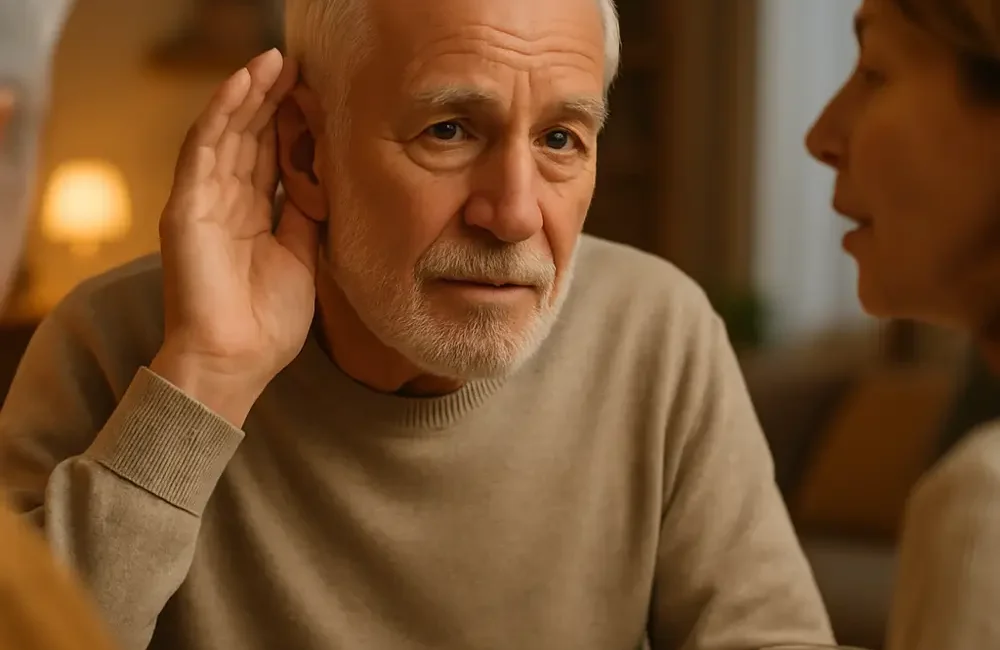
“Can you speak up?” You’ve said it more than once this week. Your partner insists the TV volume is fine; you insist it isn’t. Restaurants have gotten louder somehow, or so it seems — actual conversation across the table is work now, especially with background noise. Ugh. Here’s the thing worth knowing: this specific pattern — everyone sounding like they’re mumbling, especially in noisy places — has a real, well-documented explanation, and it’s more common than most people realize.
What’s actually happening — and it has a name
What you’re describing is a classic early sign of age-related hearing loss, medically called presbycusis. According to the National Institute on Deafness and Other Communication Disorders (NIDCD, part of the NIH), this is a gradual hearing loss that occurs in most people as they age, and it’s one of the most common conditions affecting older adults. Genuinely common — NIDCD data shows roughly one in three people in the U.S. between 65 and 74 has some degree of hearing loss, climbing to nearly half of people over 75.

Why it feels like everyone is mumbling specifically
This is the genuinely useful, specific detail: presbycusis typically affects high-frequency hearing first, before lower frequencies are noticeably impacted. A lot of consonant sounds — s, f, th, and similar sharp, high-pitched sounds — sit in that higher frequency range, while vowel sounds tend to be lower-pitched. The practical result: you can often still hear that someone is talking, and even follow the general rhythm of speech, while specific words become genuinely harder to distinguish — which is exactly why it registers as “mumbling” rather than as clearly reduced hearing. It’s not that people are speaking less clearly; it’s that the specific frequencies carrying word clarity are the ones affected first.
Background noise makes this dramatically worse, which is why restaurants, parties, and group conversations feel disproportionately harder than one-on-one conversation in a quiet room — your brain is working harder to separate speech from noise with less high-frequency information to work with.
Why it sneaks up on people
Presbycusis develops gradually, over years, which is exactly why so many people don’t notice it happening in real time. Research and clinical experience both point to the same pattern: family members and friends often notice someone’s hearing difficulty well before the person themselves does, simply because the change happens too slowly for the person experiencing it to register as a clear before-and-after shift.
Signs worth paying attention to
Beyond the “everyone’s mumbling” sensation, other common early signs include needing the TV or phone volume noticeably higher than others seem to need, difficulty following conversations in group settings or with background noise, frequently asking people to repeat themselves, and — worth mentioning since it often travels alongside hearing loss — new or persistent ringing in the ears (tinnitus), which some sources note commonly accompanies this type of hearing change.

Why this is worth addressing, not just adjusting to
It’s genuinely tempting to just quietly adapt — turning up the volume a bit more, avoiding louder restaurants, nodding along in group conversations you’re not fully following. But there’s real research worth knowing about here: hearing loss has been associated with increased risk of social isolation, and separately, with increased risk of depression and anxiety. There’s also emerging research pointing to a connection between untreated hearing loss and cognitive decline, and even a link to postural control and fall risk in older adults — likely connected to how much cognitive processing your brain devotes to interpreting sound and spatial awareness together.
None of this is meant to be alarming — it’s meant to make the case that addressing hearing changes genuinely matters beyond simple convenience, and that early evaluation and treatment can meaningfully improve quality of life, not just the volume of your TV.
What actually helps
Hearing aids remain the most common and effective treatment for age-related hearing loss, working by amplifying sound to compensate for the frequencies your ears are picking up less effectively. Modern hearing aids have improved considerably in both effectiveness and appearance compared to older assumptions many people still carry about them.
Simple communication strategies help too, in the meantime or alongside hearing aids: asking people to face you directly while speaking (so you can pick up visual and lip-reading cues you may not even realize you’re relying on), choosing quieter settings for important conversations when you have the option, and being upfront with friends and family about what’s genuinely difficult to hear, rather than nodding along and hoping to catch enough context to follow along.
Protecting the hearing you still have matters too — using earplugs in loud environments and being mindful of headphone volume can help slow further noise-related damage layered on top of the age-related component.
Getting evaluated — it’s simpler than people expect
Medical guidance specifically recommends regular hearing screening for adults 60 and older, precisely because early identification allows for treatment that can slow the practical impact and improve quality of life sooner rather than later. A hearing test through an audiologist is straightforward and non-invasive — typically involving wearing headphones and responding to a range of tones and speech at different volumes, giving a clear picture of exactly which frequencies are affected and to what degree.
Myths about age related hearing loss, cleared up
Myth: If you can still hear fine in quiet, one on one conversation, your hearing is fine. As covered above, background noise and group settings are specifically where early presbycusis shows up first, quiet one on one hearing can remain relatively strong even as noisy environment hearing genuinely declines.
Myth: Hearing aids are only for people with severe hearing loss. Modern guidance actually favors earlier intervention, even for mild to moderate loss, since earlier treatment is associated with better outcomes and easier adjustment than waiting until hearing loss becomes severe.
Myth: Wearing hearing aids makes hearing loss worse or creates dependence. Genuinely not supported, hearing aids do not damage remaining hearing or cause your natural hearing to decline faster. If anything, addressing hearing loss appropriately supports better long term outcomes.
Myth: Its just a natural, harmless part of aging not worth making a fuss about. As covered above, real research connects untreated hearing loss to isolation, depression risk, and cognitive health, treating it as a minor inconvenience undersells whats actually at stake.
A quick self-check
If youre unsure whether whats happening is worth a professional evaluation, a few honest questions can help clarify things. Do you often ask people to repeat themselves, more than youd consider normal? Do you find restaurants, parties, or group settings noticeably more exhausting or difficult to follow than they used to be? Has anyone close to you commented on your TV or phone volume, or mentioned they think you might be missing things in conversation? Do you find yourself relying more on lip reading or facial expressions than you consciously realize?
Answering yes to two or more of these is a reasonable, low pressure signal that a hearing test is worth scheduling, not a diagnosis in itself, just a genuinely useful nudge toward getting an actual, accurate picture rather than continuing to wonder.
Common questions about age-related hearing changes
Is hearing loss just an inevitable part of getting older that I have to accept?
Some degree of change is genuinely common with age, but “common” doesn’t mean “nothing can be done.” Real interventions — hearing aids, communication strategies, addressing contributing factors — meaningfully improve quality of life, and early treatment tends to produce better outcomes than waiting.
Can hearing loss happen well before typical retirement age?
Yes — while presbycusis specifically is associated with older age, noise-induced hearing loss can happen at any age, and some people experience meaningful hearing changes in their 40s or 50s, particularly with significant noise exposure history.
Does hearing loss affect both ears equally?
Typically yes for age-related hearing loss specifically — it most often affects both ears symmetrically. Hearing loss that’s significantly worse in one ear, or that came on suddenly, is worth a prompt evaluation since it can point toward a different, more specific cause.
Are hearing aids really worth it, or just an expensive hassle?
Given the documented connections between untreated hearing loss and social isolation, depression risk, and even cognitive health, most audiologists and researchers in this area consider treatment genuinely worthwhile beyond simple convenience — not just a lifestyle upgrade, but a meaningful quality-of-life and health intervention.
How is presbycusis different from tinnitus?
They’re related but distinct — presbycusis is the gradual loss of hearing ability itself, while tinnitus is the perception of sound (ringing, buzzing) without an external source. They frequently occur together, but you can have either one without the other.
The bottom line
If everyone around you increasingly sounds like they’re mumbling, especially in noisy settings, that’s a genuinely common, well-understood early sign of age-related hearing loss — not something to just quietly work around indefinitely. It affects a large share of older adults, tends to sneak up gradually, and matters for reasons beyond convenience, including real connections to isolation and cognitive health. A straightforward hearing test can tell you exactly where things stand, and real, effective treatment options exist.
This article is for general educational purposes and isn’t a substitute for professional medical advice. If you’re noticing hearing changes, please see an audiologist or doctor for evaluation.
Related reading

Emily started writing about health and wellness after watching her own mother struggle to find straight answers about perimenopause — answers that weren't buried in medical jargon or written for someone with a nursing degree. That experience shaped how she writes today. Every article on GetHealthy.Online is researched carefully and checked against trusted sources like the CDC, NIH, and Mayo Clinic — then translated into the kind of conversation you'd actually want to have with a friend who's done the homework for you. Emily isn't a doctor, and she'll never pretend to be one. When something calls for professional medical advice, she'll tell you so, plainly. Her job is to help you understand what's happening in your body, ask better questions at your next appointment, and feel a little less alone in figuring it out. She lives for the moments when a reader says, "I finally understand what my doctor was trying to explain."
Related Reading
 Brain
Brain
Memory Lapses vs. Early Dementia: How to Tell the Difference
You walk into a room and completely forget why. Or someone’s name is right there, on…
 Brain
Brain
Tinnitus: Why Ringing in the Ears Happens and What Helps
A high-pitched ringing. Maybe a buzz, a hiss, or a hum, always there, especially noticeable the…
 Brain
Brain
Brain Fog After 50: Normal Aging or Something More?
You walk into a room and blank on why. A word you know perfectly well just…
 Brain
Brain
Why Perimenopause Brain Fog Is Real (And Why Almost No One Talks About It)
Forgetting words mid-sentence? Walking into rooms and blanking? If you're in your 40s or 50s, perimenopause…